A chimney cap is the metal cover, usually stainless steel or copper, that mounts over the top of the flue with a mesh screen on its sides. The Chimney Safety Institute of America (CSIA) treats the cap and its…
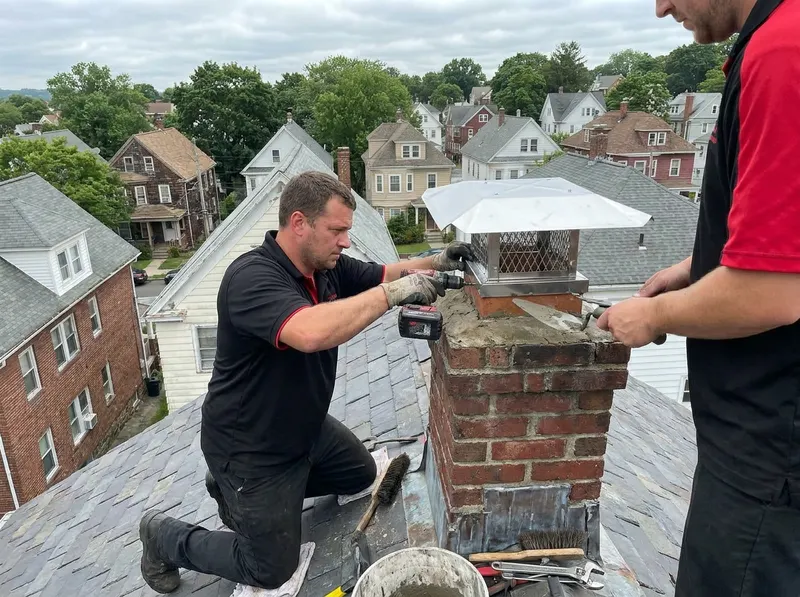
A chimney cap is the metal cover, usually stainless steel or copper, that mounts over the top of the flue with a mesh screen on its sides. The Chimney Safety Institute of America (CSIA) treats the cap and its spark-arrestor mesh as basic weather and ember protection, and NFPA 211 references screening at the flue top to limit sparks. When high wind blows a chimney cap back from the chimney, the exposed flue then takes on rain, leaves, and squirrels, and moisture speeds up interior tile and mortar decay.
Three situations cover most cap calls in Hartford. First, a cap that came loose or blew off: if the friction band or mounting screws simply worked free and the cap itself is undamaged, it can be reattached in one visit. Second, a rusted-through or bent cap that no longer keeps rain out: this calls for a new cap sized to the flue, typically stainless for corrosion resistance. Third, damage below the cap at the concrete crown, the sloped slab the cap sits on. A cracked crown lets water into the chimney even with a perfect cap, so chimney crown repair sometimes accompanies the cap work. On the older masonry chimneys common in the West End and Asylum Hill, a hairline crown crack is easy to miss from the ground and is confirmed only from the roof.
Sizing matters because caps are not one-size. A single-flue clay tile in a Frog Hollow or Barry Square two-family often takes a standard band-mount cap that clamps to the tile. Wide masonry crowns with multiple flues, seen on larger homes near Elizabeth Park and in Blue Hills, usually need an outside-mount or full multi-flue cap that covers the entire crown, which costs more and takes longer to fit. If the flue tile itself is cracked or the crown is crumbling, a cap alone will not stop the leak, so the top of the chimney is checked as one unit.
The report is where FlueGuard differs: every cap visit includes photos of the crown, the flue top, and the old cap so the homeowner sees the actual condition rather than a verbal claim. The work fits inside a CSIA Level 1 inspection for a straightforward, accessible chimney; a Level 2 inspection applies if there was a property transfer, a chimney fire, or a change in the appliance. If you noticed something that could be fixed, a cap hanging loose, a screen torn open by animals in Parkville or Upper Albany, or staining on the ceiling near the chimney in Sheldon-Charter Oak, South Green, or Behind the Rocks, a technician can take a look and confirm what the top of the chimney needs. A free on-site estimate is available before any cap or crown work is scheduled.
Every job gets a firm, written price after a free on-site visit.
Tell us about your chimney cap repair & replacement job in Hartford and we'll send a clear, written quote, usually the same day.
 Flue Guard Chimney Sweep