Animal entry through an uncapped flue is common across older Hartford housing stock, and the fix has two parts: remove the intruder, then seal the top. Chimney swifts, starlings, raccoons, and gray squirrels use…
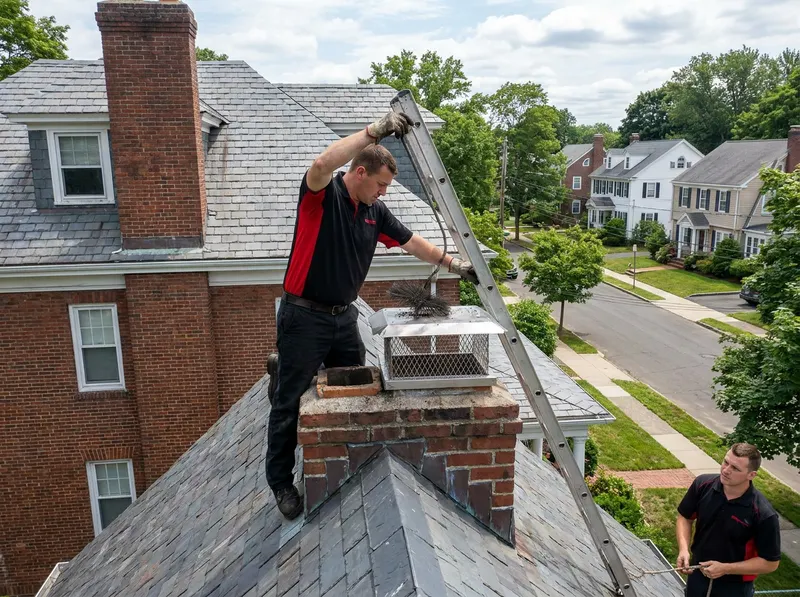
Animal entry through an uncapped flue is common across older Hartford housing stock, and the fix has two parts: remove the intruder, then seal the top. Chimney swifts, starlings, raccoons, and gray squirrels use unscreened flues in neighborhoods like Asylum Hill, the West End, and Frog Hollow, where brick chimneys built decades before modern capping standards sit exposed near mature trees around Elizabeth Park and Keney Park. To remove a bird from a chimney, technicians first identify whether it is trapped on the smoke shelf or nesting higher in the flue, because a live raccoon on the damper is handled differently than a swift stuck against the crown.
Nesting debris is a fire and blockage hazard. When a nest is left in place, it obstructs airflow and can ignite from spark contact, which is why the standard sequence is to remove the nest and clean out the chimney before any cap goes on. The National Fire Protection Association standard NFPA 211 addresses obstruction and clearance in venting systems, and the Chimney Safety Institute of America (CSIA) defines the Level 1 inspection for readily accessible flues and the Level 2 inspection used after an animal intrusion or before a cap change. A Level 2 scan with a camera confirms the flue is clear of nesting material, droppings, and structural damage before it is closed.
The spark arrestor and animal guard is the permanent exclusion. Two options fit most homes: a standard galvanized or aluminum cap-and-screen, and a heavier custom, ideally 316 stainless mesh animal spark arrestor. The 316 grade is chosen in Hartford because it holds up to winter road salt spray and the freeze-thaw cycles that corrode lighter metal within a few seasons. A single-flue chimney takes an off-the-shelf mesh cap; a wide or multi-flue crown in a South Green or Barry Square two-family often needs a custom chimney animal guard fabricated to the crown dimensions. If the goal is to keep the raccoons out, the screen opening matters more than the metal: raccoons and squirrels are excluded by a fitted top-mount cap with mesh no wider than 3/4 inch and a secure crown mount, since a loose lift-off cap can be pried up.
Decision guidance is straightforward. If a bird is chirping and you only hear it during daylight, that is usually a trapped swift or starling and a same-visit removal fits. If you hear heavy scratching, thumps, or activity at dusk near Blue Hills, Upper Albany, or Parkville, that points to a raccoon or squirrel, and removal must confirm no kits or young remain before capping, capping over a live animal traps it. During spring nesting season, chimney swifts are federally protected, so an active swift nest with young may require waiting until the birds fledge before cleanout and capping proceed. Homeowners in Sheldon-Charter Oak and Behind the Rocks comparing options are encouraged to get some quotes; a free on-site estimate measures the crown, confirms flue count, and prices the exact mesh cap or custom guard before any work begins.
Every job gets a firm, written price after a free on-site visit.
Tell us about your animal removal & spark arrestor job in Hartford and we'll send a clear, written quote, usually the same day.
 Flue Guard Chimney Sweep